The News Now Ladakh EditionThe News Now Ladakh Edition
  • Home
  • Featured Stories
    Featured StoriesShow More
    Ladakh to Get Hill Councils in All Seven Districts; UT-Level Body Under Article 371 Under Discussion
    July 13, 2026
    GAD Organises Orientation Workshop on Mission Karmayogi and Departmental Capacity Building Plans
    July 8, 2026
    Chief Secretary Ashish Kundra undertakes Two-Day tour of Changthang, reviews development projects and public grievances
    July 8, 2026
    Administrative Secretary, Industries & Commerce Department chairs meeting on Strengthening Operations and Management of Brand Ladakh Showroom in New Delhi
    July 8, 2026
    Three Day Envisioning Zanskar Summit 2026 Commences at Government Degree College Zanskar
    July 8, 2026
  • Ladakh
    LadakhShow More
    Ladakh to Get Hill Councils in All Seven Districts; UT-Level Body Under Article 371 Under Discussion
    July 13, 2026
    Director, Sheep Husbandry Department, UT Ladakh Visits Khaltsi; Attends National Livestock Mission Awareness Camp at Temisgam
    July 8, 2026
    Orientation Programme on Mission Karmayogi Conducted by Capacity Building Commission Held at DC Office, Nubra
    July 8, 2026
    DIET Leh Organizes Workshop for Reframing of Bhoti Textbooks
    July 8, 2026
    DIET Leh Monitors Term-I Exams Across District Schools
    July 8, 2026
  • Kargil
    KargilShow More
    Ladakh to Get Hill Councils in All Seven Districts; UT-Level Body Under Article 371 Under Discussion
    July 13, 2026
    DC Drass Reviews Disaster Management Preparedness, Directs Round-the-Clock Readiness
    July 8, 2026
    ALSWAC Delegation Meets CEC Kargil, Discuss KSSRB Results and Pending Scholarships
    July 8, 2026
    DIET Kargil and 17000ft Foundation Launch Summer Vacation Worksheets for Joyful continued Learning
    July 8, 2026
    CEC Kargil Attends Training-cum-Awareness Programme on Conservation and Registration of Niche-Specific Arid Crops and Farmers’ Varieties
    July 8, 2026
  • Governance
    GovernanceShow More
    Ladakh to Get Hill Councils in All Seven Districts; UT-Level Body Under Article 371 Under Discussion
    July 13, 2026
    Positive Discussions Underway On UCC, ‘One Nation, One Election’: PM Modi
    April 6, 2026
    SC Orders CBI Enquiry Into Award Of Contracts To Firms Linked To Arunachal CM’s Kin
    April 6, 2026
    Nation’s Prosperity Key To Individual Progress: Mohan Bhagwat
    April 6, 2026
    Judicial Infrastructure Not Optional But Essential: CJI Surya Kant
    April 6, 2026
  • Opinion
    OpinionShow More
    Kucha: India’s Buddhist Imprint on the Silk Route
    June 20, 2026
    THE INDIAN ARMY: UNSUNG HEROES OF LADAKH’S RENEWABLE ENERGY REVOLUTION
    April 22, 2025
    The Khelo India Winter Games 2025
    April 22, 2025
    Changthang: The Highest Wildlife Reserve
    April 22, 2025
    Women Empowerment Centre, Sankoo: A Step Towards Self-Reliance
    April 22, 2025
  • Articles
    ArticlesShow More
    Five-day disability and senior citizen assessment camp concludes in Kargil
    July 22, 2025
    THE INDIAN ARMY: UNSUNG HEROES OF LADAKH’S RENEWABLE ENERGY REVOLUTION
    April 22, 2025
    The Khelo India Winter Games 2025
    April 22, 2025
    Changthang: The Highest Wildlife Reserve
    April 22, 2025
    Women Empowerment Centre, Sankoo: A Step Towards Self-Reliance
    April 22, 2025
Reading: Kucha: India’s Buddhist Imprint on the Silk Route
Share
The News Now Ladakh EditionThe News Now Ladakh Edition
  • Home
  • Featured Stories
  • Ladakh
  • Kargil
  • Governance
  • Opinion
  • Articles
Search
  • Home
  • Featured Stories
  • Ladakh
  • Kargil
  • Governance
  • Opinion
  • Articles
Follow US
  • Advertise
© 2024 The New Now Ladakh. All Rights Reserved. | Powered by Ideogram Technology Solutions [P] Ltd.
The News Now Ladakh Edition > Blog > Opinion > Kucha: India’s Buddhist Imprint on the Silk Route
Opinion

Kucha: India’s Buddhist Imprint on the Silk Route
The News Now
Last updated: June 20, 2026 1:29 pm
The News Now
Share
6 Min Read
SHARE

Bharath Nanda
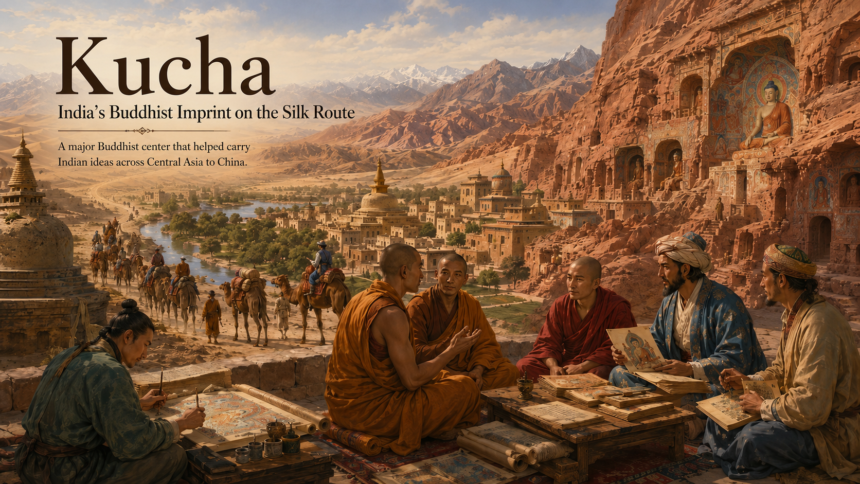
Kucha deserves a far more serious place in India’s reading of Central Asian history than it usually receives. It was no mere oasis town on the Silk Route; it was one of the principal Buddhist centres of the Tarim Basin, and it played a real part in carrying Indian religious and intellectual traditions towards China.
Set near the northern edge of the Taklamakan Desert, Kucha held an important position on the route linking India, Central Asia and China. In the old caravan world geography counted for a great deal, and a settlement placed on a difficult but busy road became something more than a marketplace — it became a meeting ground for traders, monks, artists, translators and travellers alike. Kucha was one such meeting ground.
Its connection with India came chiefly through Buddhism. The faith that began in India travelled through Kashmir, Gandhara and the other north-western regions before reaching the oasis kingdoms of Central Asia, and Kucha not only received this tradition but developed it and helped send it further east. That role made the kingdom a vital link in the chain through which Buddhist Asia took shape.
Few things show this connection more clearly than the Kizil Caves near Kucha. Their murals reflect a mix of influences, yet the core themes remain Buddhist, and the stories, symbols and spiritual ideas behind them came from the Indian Buddhist world. They reveal how Indian religious imagination was taken up in Central Asia and given form by local artistic hands.
Kucha was a place of learning as well. Its monasteries and strong Buddhist presence were not merely religious institutions; they were centres where texts were studied, translated and explained. In a world without printing or modern communication, such places preserved knowledge and allowed it to travel across great distances.
The figure most closely tied to Kucha is Kumarajiva. Born there, with family roots traditionally traced to Kashmir, he became one of the greatest translators of Buddhist texts into Chinese, giving Chinese Buddhism some of its most influential scriptures and interpretations. Through his work, Indian ideas did not merely reach China — they entered Chinese intellectual life and stayed there.
Kumarajiva’s story is itself the reason Kucha cannot be dismissed as a minor stop on a trade route. Here the Indian, Central Asian and Chinese worlds met and mingled; the kingdom received from India, reshaped what it received, and passed it on. That made Kucha a transmitter, not merely a recipient.
Xuanzang’s travels in the seventh century confirm the importance of this wider region. His road to India ran through the Buddhist centres of Central Asia, and while India was, for pilgrims like him, the original source of Buddhist knowledge, the journey to that source depended on places such as Kucha, where Buddhism had already struck deep roots.
This is the part of the story India tends to overlook. The arrival of Buddhism in China is well known; the road by which it travelled is much less understood. Between India and China stood a chain of societies that carried, protected and interpreted Indian thought, and Kucha was among the most important of them.
India’s influence in Kucha was not that of a state but of a civilisation. No army was required for Indian ideas to take hold there — monks, manuscripts, teachers, traders and artists did the work. This is what gave Indian culture its reach across Asia: it moved through respect rather than compulsion.
The history has its present-day relevance too. India’s conversation about Central Asia today usually turns on connectivity, energy, trade and security, and these are real concerns. But the older foundation of the relationship was cultural and intellectual, and Kucha reminds us that India’s engagement with the region is no recent strategic discovery; it carries a long memory behind it.
That memory should be handled with balance. Kucha was not India — it had its own people, languages and political life — yet it was deeply marked by Indian Buddhist traditions, and its art, learning and religious institutions belonged to a larger Asian Buddhist network that had India at its source.
Kucha stands, then, as an important chapter in India’s civilisational outreach, a place where ideas born in India crossed deserts, entered foreign societies and became part of their spiritual life. In that sense it was not only a bridge between India and China but one of the workshops in which Buddhist Asia itself was made.

You Might Also Like

THE INDIAN ARMY: UNSUNG HEROES OF LADAKH’S RENEWABLE ENERGY REVOLUTION

The Khelo India Winter Games 2025

Changthang: The Highest Wildlife Reserve

Women Empowerment Centre, Sankoo: A Step Towards Self-Reliance

The Lhasa Massacre: A Testament to Tibetan Resilience Against Chinese Oppression

Share This Article
Facebook Twitter
Share
Previous Article Ladakh records over 43 pc rise in tourist arrivals in 2026, May sees over 121 pc growth: LG
Next Article 91st Birth Anniversary of His Holiness the 14th Dalai Lama Celebrated with Great Devotion in Ladakh
Leave a comment Leave a comment

Leave a Reply Cancel reply

Your email address will not be published. Required fields are marked *

Stay Connected

235.3kFollowersLike

Latest News

Ladakh to Get Hill Councils in All Seven Districts; UT-Level Body Under Article 371 Under Discussion
Featured Stories Governance Kargil Ladakh July 13, 2026
DC Drass Reviews Disaster Management Preparedness, Directs Round-the-Clock Readiness
Kargil July 8, 2026
ALSWAC Delegation Meets CEC Kargil, Discuss KSSRB Results and Pending Scholarships
Kargil July 8, 2026
DIET Kargil and 17000ft Foundation Launch Summer Vacation Worksheets for Joyful continued Learning
Kargil July 8, 2026
The News Now Ladakh EditionThe News Now Ladakh Edition
Follow US
© 2024 The News Now Ladakh Edition. All Rights Reserved. | Powered by Ideogram Technology Solutions [P] Ltd.
Welcome Back!

Sign in to your account

Lost your password?