
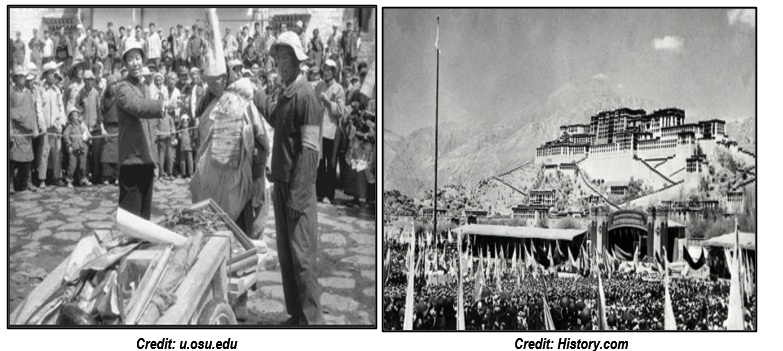
On 10th Mar, 1959 the Tibetan uprising began as a response to fears that the Chinese authorities planned to abduct the 14th Dalai Lama, Tibet’s spiritual leader. Tens of thousands of Tibetans gathered around the Norbulingka Palace to protect him, defying the presence of the People’s Liberation Army (PLA). Initially peaceful, the protests escalated into armed clashes with Chinese forces. By March 17, with artillery aimed at the palace, the Dalai Lama fled to India, embarking on a perilous journey across the Himalayas.
The PLA launched a full assault on Lhasa on March 19, 1959, leading to intense fighting over the next few days. Estimates of casualties vary widely due to restricted access to data and China’s control over information. The Tibetan Government-in-Exile claims that 87,000 Tibetans perished during the uprising and its immediate aftermath, while historian Warren W. Smith suggests that between 10,000 to 15,000 Tibetans were killed in Lhasa alone. Chinese sources report a far lower toll, claiming only 2,000 rebels died, a figure widely disputed as an underestimation.
On 25 March 1959, Chinese forces entered Lhasa and violently suppressed the Tibetan uprising, resulting in significant casualties with thousands killed, injured, or imprisoned. Despite the brutal crackdown, the uprising became a powerful symbol of Tibetan resistance against Chinese rule, representing the struggle for independence and the preservation of Tibetan culture. March 25 is now marked as a day of remembrance, calling for global support for Tibet’s ongoing fight for autonomy and human rights.
Credit: u.osu.edu Credit: History.com
The atrocities that followed the crackdown were severe. The PLA executed the Dalai Lama’s bodyguard unit in public, machine-gunning them as a warning to dissenters. House-to-house searches targeted suspected rebels, with residents harbouring arms summarily shot. The International Commission of Jurists documented these acts in its 1959 report, labelling them as systematic efforts to crush Tibetan resistance and culture.
The Lhasa Uprising has become a powerful symbol of Tibetan resistance against Chinese rule, representing the struggle for independence and the preservation of Tibetan culture. March 10 is observed by exiled Tibetans as Tibetan Uprising Day, while March 25 is marked as a day of remembrance, calling for global support for Tibet’s ongoing fight for autonomy and human rights.
Today, Tibet remains under tight Chinese control, with severe restrictions on freedoms of speech, press, and political expression. Tibetans are subjected to disappearances, torture, and arbitrary detention. The Chinese government has also implemented policies aimed at erasing Tibetan culture through Sinicization, leading to allegations of cultural genocide.
The Lhasa Uprising of 1959 stands as a testament to the resilience of the Tibetan people in the face of oppression. The brutal crackdown by Chinese forces resulted in significant casualties and human rights abuses, which continue to shape the political and cultural landscape of Tibet today. As the world marks the anniversary of this pivotal event, it is crucial to remember the sacrifices made by Tibetans and to support their ongoing struggle for autonomy and human rights.
The Lhasa Massacre serves as a powerful reminder of the importance of protecting human rights and cultural identity. The international community must remain vigilant about the situation in Tibet and press for greater transparency and accountability from China regarding its actions in the region.
Sources:
https://www.nysun.com/article/editorials-lhasa-massacre
https://www.rfa.org/english/commentaries/woeser-10042013105742.html
https://www.dw.com/en/tibet-uprising-60-years-on-the-fight-continues/a-47825434