
Arteev Sharma
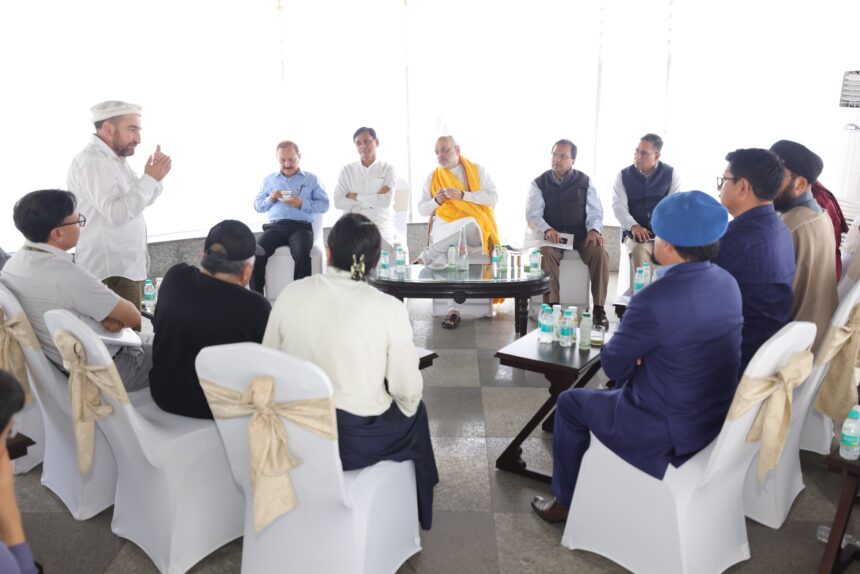
Jammu: A day after reaching a consensus on the implementation of a 15-year prospective residency requirement for domicile status in Ladakh, leaders from the Leh Apex Body (LAB) and Kargil Democratic Alliance (KDA) met Union Home Minister Amit Shah in New Delhi on Wednesday, requesting him to expedite the recruitment process for various gazetted and non-gazetted posts in the Union Territory.
According to the delegation members, the Union Home Minister assured them of a “time-bound continuation” of the ongoing dialogue between the Ministry of Home Affairs (MHA) and Ladakh representatives to address key issues, including the long-standing demands for Statehood and inclusion of Ladakh under the Sixth Schedule of the Constitution.
“We met the Union Home Minister in New Delhi and thanked him for continuing the dialogue. He assured us that the talks would proceed in a time-bound manner to address all outstanding concerns,” said Sajjad Kargili, senior KDA leader, while speaking to The News Now.
He said they requested the Union Home Minister that the dialogue process should continue to hold discussions on the issue of Statehood and Sixth Schedule for Ladakh.
The assurance comes a day after LAB and KDA leaders agreed with the MHA to implement a 15-year residency rule—starting from 2019—for domicile eligibility. This was against the 30 years of continuous residency in Ladakh which was being insisted upon by two groups.
The KDA leader said, “We requested the Union Home Minister for expediting the recruitment for various district and state cadre posts after the consensus over the domicile issue during yesterday’s meeting of the High Powered Committee, chaired by Union Minister of State for Home Nityanand”.
Under the new domicile framework, all non-gazetted posts are reserved for Ladakh residents. Additionally, 95 percent of gazetted positions will be reserved to locals, with only a 5 percent quota for other domiciles.
“We have a long-pending four-point agenda from 2019: Statehood for Ladakh, a public service commission, solving unemployment issues, and proper representation in Parliament. After prolonged talks with the Home Ministry, we recently resolved deadlocks on domicile rules, reservation for gazetted posts, and fast-tracking recruitment,” Kargili said.
The LAB and KDA had been asking for 30 years residency in Ladakh for acquiring the status of domicile. The leaders from LAB and KDA said the Home Ministry has agreed to send the proposal of a 30 years timeline for domicile to the Union Law Ministry for examination and the outcome will be discussed in the next HPC meeting scheduled for next month.
The leaders have also been claiming that the separate Ladakh Administrative Services and Ladakh Police Services on the lines of JKAS and JKPS are under active consideration and it is going to be a reality soon. They said the issue may come under consideration during the next meeting of the HPC.
Meanwhile, a delegation of Kargil leaders, comprising Member of Parliament from Ladakh Haji Hanifa Jan and Chief Executive Councillor (CEC), Kargil Council Dr Jaffer Akhone also met Union Home Minister in New Delhi today and submitted a memorandum demanding district status for Sankoo sub-division.
The delegation also comprised former ministers, councilors and religious leaders from Kargil district. In their representation, the leaders expressed gratitude to the Union Home Ministry for the recent announcement of five new districts in Ladakh and alleged that Sankoo, despite being one of the most deserving regions, has been overlooked.
They demanded that Sankoo should be given as a separate district as the sub-division is the most populous subdivision in the entire Union Territory, comprising 36 villages and a population of 40,548.
“In comparison, other regions recently considered (e.g., Zanskar— 13,793; Nubra — 22,433) have much smaller populations. The subdivision has 26 high schools and six higher secondary schools (I-ISS Sankoo, HSS Panikhar, HSS Barsoo, HSS Lankerchey, HSS Byamachan and HSS Trespone. Notably, nine councillors in the Ladakh Autonomous 1121 Development Council (LAHDC) are elected from the Sankoo subdivision, underlining its political and administrative weight,” they said in their representation.
They also claimed that Sankoo lies at a higher altitude than Kargil and experiences heavy snowfall from November to April, frequently disrupting road connectivity to Kargil. “These harsh weather conditions isolate the population, particularly students, from accessing higher education, healthcare, and essential services. Establishing a district administration within Sankoo would reduce dependency on Kargil and improve timely service delivery during critical winter months. With a large and spread-out population, the administrative burden on Kargil is significantly high,” they said.