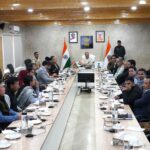


Leh, September 3: The Planet Local Summit Ladakh 2025 began today at the Lamdon School Auditorium, with participants from across India and several countries coming together to deliberate on culture, environment, and sustainable futures.
Hon’ble Deputy Chairman, LAHDC Leh, Shri Tsering Angchuk, attended the opening day as the Chief Guest.
Organised by Local Futures, the summit is a landmark international gathering running from September 3 to 7, bringing together participants from Ladakh, the rest of India, and around the world to advance a shared vision of change rooted in local economies, cultures, and community resilience. This year’s event also marks 50 years of pioneering work in Ladakh by Helena Norberg-Hodge, founder of Local Futures, who is leading the programme alongside regional and global thought-leaders and activists.
The welcome session featured Helena Norberg-Hodge, a long-time friend of Ladakh; Stanzin Gya, a renowned filmmaker and environmentalist; Tsewang Chujung, an educationist and community leader; and Tsewang Namgail, a leading conservation biologist. They shared their diverse professional journeys and experiences, underlining how culture, ecology, and community action are deeply intertwined in Ladakh. Tsewang Chujung also spoke about the enduring influence of Helena Norberg-Hodge in Ladakh, noting that she was recently honoured with a Special Appreciation Award during the Ladakh Spal Ngam Duston 2025 for her decades-long contribution to cultural and environmental conservation. Their reflections set the tone for the summit by connecting global challenges with local realities and highlighting the value of sharing knowledge across regions and professions.
A cultural performance by Dorjay Stakmo and Stanzin Kunzel added vibrancy to the day, celebrating Ladakh’s rich artistic traditions.
As part of the programme, an interactive session was held between Chief Guest Dy Chairman, LAHDC Leh, Shri Tsering Angchuk, and Shri Padma Rigzin, a social anthropologist from Ladakh and member of Local Futures. Their conversation revolved around politics, ecology, and the agricultural challenges of the region, with questions and reflections flowing between them.
When asked about the preservation of Ladakh’s ecology, Dy Chairman Angchuk recalled the contributions of the generation that had worked with Helena Norberg-Hodge to safeguard the region’s culture, language, and natural resources. He also reflected on his own journey before entering politics, sharing how those formative experiences shaped his commitment to sustainable development in Ladakh.
Additionally,when asked about the ecological and environmental concerns and the role of LAHDC, Dy Chairman Angchuk highlighted a range of initiatives being pursued, such as the introduction of e-cycles, hydrogen and electric buses, and efforts to subsidise and customise eco-friendly vehicles suited to Ladakh’s terrain. He stressed that these measures must be accompanied by awareness campaigns and active grassroots participation. He also underlined the importance of long-term sustainability, noting that it was LAHDC that had framed an organic mission policy in 2018 with the goal of making Ladakh self-sustainable and fully organic, as it once was before modern technologies were introduced in the region.
Responding to a question on the role of Panchayati Raj institutions, he noted that agriculture, animal husbandry, horticulture, and supplies are closely interlinked, and called for collective efforts at the village and panchayat levels to ensure sustainable practices.
The day concluded with participants mingling and interacting informally, creating a vibrant space for the exchange of ideas and strengthening connections before dispersing after the lunch session.