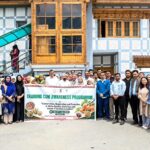


Leh: The students of B.Sc. (Hons.) Agriculture, School of Agriculture Sciences and Technology (SAS&T), University of Ladakh, along with faculty members Dr. Lobzang Stanzen (Assistant Professor) and Dr. Padma Angmo (Assistant Professor), undertook an educational visit as part of their second-semester practical curriculum. The visit included multiple key facilities in and around Leh: the Sewage Treatment Plant (STP) and Bull Mother Farm in Agling, the Solid Waste Management Plant at Skampari, and Demazong Enterprises in the Solar Colony.
At the Sewage Treatment Plant, Mr. Shahed Ahmed Loan provided a comprehensive explanation of the sewage treatment process. He demonstrated how wastewater is treated and transformed into reusable water suitable for agricultural purposes. The students observed each stage of the treatment process, gaining a practical understanding of wastewater management and its significance in sustainable agriculture. In addition, Mr. Mohazeb Nabi, the laboratory chemist, briefed the students on the laboratory instruments used in the STP. He explained the standard procedures followed to test plant efficiency and elaborated on key water quality parameters monitored daily. The students also learned about the permissible limits for treated water as prescribed by the Central Pollution Control Board (CPCB).
Following the STP visit, the students proceeded to the Bull Mother Farm, where they learned about the Jersey breed of cattle and the process of artificial insemination. They also visited the shedding house and were introduced to the concept of “flashing” used in livestock management.
The next stop was the Solid Waste Management Plant at Skampari, where the students witnessed the manual segregation of waste and learned about the various tools and techniques used in waste separation. Mr Tsering Dorjay (Plant manager) explained the entire solid waste management process-from segregation to landfill disposal. Students were particularly interested in how compost is produced from organic (wet) waste, which is then supplied to the Agriculture Department for use in farming practices.
The visit concluded with an insightful session at Demazong Enterprises, located in the Solar Colony, Leh. Here, the focus shifted to renewable energy and its application in sustainable development. The Director and owner, Mr. Konchok Tharchin, briefed the students on the immense potential of solar energy in Ladakh and its critical role in protecting the region’s fragile ecosystem. The visit included a guided tour of the facility, where students explored rooftop solar power systems, solar-heated buildings, and solar water heaters. Mr. Tharchin provided comprehensive explanations of each system’s functionality, offering the students valuable real-world insights into solar technology applications.
This educational visit provided the students with practical exposure to critical environmental and agricultural processes and is expected to inspire innovative thinking around sustainability and eco-friendly solutions in agriculture and beyond.