
Jammu: In a significant reshuffling within the police department, the Home Department of the Union Territory of Ladakh has announced several key transfers and postings of police officers with immediate effect.
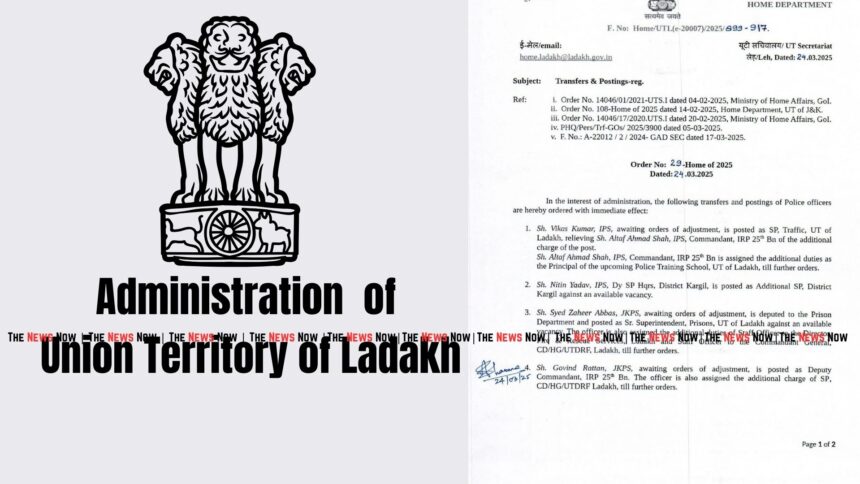
The orders, issued under Order No. 29-Home of 2025, aim to streamline administrative efficiency and strengthen the region’s law enforcement operations.
As per the new order, Vikas Kumar, IPS, who was awaiting orders of adjustment, has now been appointed as SP, Traffic for the UT of Ladakh, relieving Altaf Ahmad Shah, IPS, Commandant of IRP 25 Bn of the additional charge of the position.
Altaf Ahmad Shah will now take on the additional responsibilities as the Principal of the upcoming Police Training School in Ladakh, where he will oversee its establishment and operations.
Meanwhile, Nitin Yadav, IPS, who was serving as Dy SP Hqrs in District Kargil, has been transferred to the position of Additional SP, District Kargil to fill an available vacancy in the district.
Syed Zaheer Abbas, JKPS, who had been awaiting orders of adjustment, has been deputed to the Prison Department and appointed as Sr. Superintendent of Prisons in Ladakh. In addition to his new responsibilities, he has also been assigned the role of Staff Officer to the Director, Fire & Rescue Services and Staff Officer to the Commandant General, CD/HG/UTDRF, until further orders.
Furthermore, Govind Rattan, JKPS, who was also awaiting orders of adjustment, has been appointed as Deputy Commandant, IRP 25 Bn. He has also been entrusted with the additional charge of SP, CD/HG/UTDRF Ladakh.
In another significant move, Anayatullah, DySP, Traffic in District Kargil, has been transferred to the post of DySP Hqrs, District Kargil, replacing Nitin Yadav, IPS.
Asif Mustafa, JKPS, currently serving as DySP in CD/HG/UTDRF Kargil, has been assigned the additional charge of DySP Traffic, District Kargil.
These strategic transfers are part of ongoing efforts to enhance security and improve the functioning of law enforcement agencies in Ladakh. The reshuffling of senior officers is seen as a step towards better coordination and efficient service delivery in the region, especially in the light of growing administrative challenges.