
Tibetans resist China’s renaming policy in TAR through protest and rallies in India and abroad on their special occasion of uprising day which seeks to replace “Tibet” with “Xizang,” erasing cultural identity and asserting sovereignty. This move is part of China’s broader strategy to Sinicize Tibet, sparking international criticism and calls for preserving Tibetan heritage.
Tibet has historically been a distinct cultural and political entity, with its own language, religion, and traditions. However, in 1951, China annexed Tibet, leading to decades of political and cultural tensions. The Chinese government has consistently sought to integrate Tibet into the Chinese nation-state, often at the expense of Tibetan autonomy and cultural heritage.
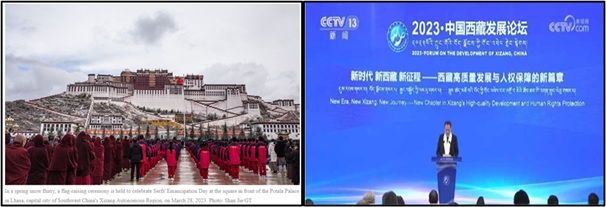
As per the news article published in Firstpost, the decision to replace “Tibet” with “Xizang” in official documents is seen as a deliberate attempt to erase Tibetan identity and legitimize Chinese rule. “Xizang” is the Mandarin Chinese term for Tibet, and its use in English-language documents reflects Beijing’s efforts to impose its linguistic and cultural dominance over the region. For instance, during the devastating earthquake in Tibet on 07 January 2025, China emphasized using “Xizang” instead of “Tibet” in global communications, reinforcing its narrative of sovereignty. This renaming undermines Tibetan culture and identity amidst the region’s humanitarian crisis
Many Tibetans and Tibetan diaspora view this move as an assault on their cultural identity and heritage. The Tibetan Policy Institute’s Dawa Tsering described it as a “terribly bad political manoeuvre” aimed at legitimizing China’s occupation of Tibet.
The international community has also expressed severe concern over China’s actions. The use of “Xizang” instead of “Tibet” is seen as part of a broader strategy to control the narrative around Tibet and undermine the Dalai Lama’s influence.
China’s policies have also targeted Tibetan language and education through education reform policies in TAR. Tibetan-language schools are being dismantled, and Mandarin Chinese is being enforced as the primary language of instruction. This has led to fears that Tibetan culture will be reduced to mere “performative purposes” for tourists.
The promotion of Mandarin and Chinese culture in Tibet is part of a broader Sinicization policy aimed at assimilating ethnic minorities into the dominant Han Chinese culture. This has resulted in a sharp decline in the use of Tibetan language and cultural practices in TAR.
By renaming Tibet as “Xizang,” China aims to consolidate its political control over the region and abroad. This move is part of a larger effort to suppress any claims to Tibetan autonomy or independence since invasion. China also seeks to integrate Tibet economically into the Chinese mainland. The region is rich in natural resources, and its strategic location makes it crucial for China’s Belt and Road Initiative.
China’s renaming policy is a symptom of a larger issue, the systematic erosion of Tibetan identity and heritage. As the international community watches, it is crucial to recognize the cultural and political implications of such actions at each and every level. The preservation of Tibetan culture requires not only the protection of its language and traditions but also the acknowledgment of its distinct identity and history.
In the face of these challenges, Tibetans and their supporters worldwide continue to advocate for the preservation of Tibetan culture and autonomy. The struggle to maintain Tibetan identity in the face of Chinese assimilation policies remains a pressing issue, requiring sustained international attention and support.
China’s renaming of Tibet as “Xizang” in official documents represents a calculated effort to assert sovereignty, legitimize its occupation, and erode Tibetan cultural identity. This move aligns with broader Sinicization policies targeting Tibetan language, education, and traditions. By imposing the Mandarin term globally, China seeks to reshape international discourse and diminish the Dalai Lama’s influence while promoting its political narrative. This renaming push is part of a systematic campaign to erase Tibetan heritage and rewrite history in TAR. Preserving Tibet’s distinct identity requires global resistance to such policies and advocacy for the protection of Tibetan culture, language, and autonomy.
Tibet Uprising Day: A Legacy of Resistance Against China’s Renaming Policy


Leave a comment
Leave a comment