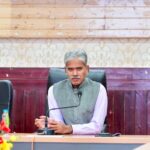


Leh, July 13: The Union Territory Administration has announced that Ladakh Autonomous Hill Development Councils (LAHDCs) will be established in all seven districts of the Union Territory, marking what it described as a significant step towards democratic decentralisation and strengthening grassroots governance.
Addressing a press conference on Monday, Chief Secretary Ashish Kundra said the decision follows recent discussions between the Ministry of Home Affairs (MHA), the Apex Body Leh and the Kargil Democratic Alliance (KDA).
He said the administration would amend the LAHDC Act wherever necessary and undertake constituency delimitation before constituting the new Hill Councils in the newly created districts.
Kundra also said discussions are progressing on a customised constitutional framework for Ladakh under Article 371. He said a Union Territory-level body with legislative, executive, financial and administrative powers has been proposed as part of the ongoing consultations.
“The structure and powers of the proposed body will be finalised after consultations with Ladakh’s representatives and the Government of India,” he said.
On employment, the Chief Secretary said more than 4,500 government posts have either been filled or their recruitment process completed since Ladakh became a Union Territory. Recruitment for another 1,684 posts is currently underway.
He announced that advertisements would soon be issued for 262 Primary and Upper Primary Teacher posts, 47 posts in the University of Ladakh and 331 Constable posts.
Highlighting administrative reforms, Kundra said the creation of 17 new tehsils has been followed by the posting of tehsildars, while new divisions under the Public Works Department (PWD), Pradhan Mantri Gram Sadak Yojana (PMGSY) and Public Health Engineering (PHE) have also been established to strengthen district-level administration and improve service delivery across all seven districts.
He reiterated that the administration remains committed to taking governance closer to the people, particularly those living in remote and border areas. Senior officers, he said, will regularly visit the newly created districts to address public grievances and monitor developmental works on the ground.
Kundra also said the administration is examining public objections received on the proposed Excise Policy before taking a final decision.
On local governance, he clarified that Panchayati Raj Institutions will continue to function alongside the proposed Hill Councils, while additional district-level posts will be created in phases as the administrative structure expands.
The announcements come amid sustained dialogue between the Centre and Ladakh’s civil society organisations on demands relating to constitutional safeguards, enhanced decentralisation and institutional reforms following the creation of the Union Territory in 2019.